Serre D’op – Green Heights as a Response to Urbanisation
In an increasingly urbanised world, the livability of cities is coming under increasing pressure. Cities grow, densify and turn into stony landscapes where nature finds it increasingly difficult to find a place. In Ghent — and more specifically in the station district, where houses are built close together — this problem is becoming tangible. Street-level space is scarce and largely already in use, while calls for more greenery, biodiversity and social connection are only getting louder. Serre D’op is a response to this challenge. This design proposal transforms unused roofs into green, communal conservatories — literally and figuratively new breathing space above the city. The project starts from a need, but at the same time constitutes an invitation: to look at the city differently, to breathe new life into unseen places, and to reconnect — with each other and with nature.
The Spatial Reality
Ghent, like many other cities, is under pressure. The concrete ban has become a reality, and the search for quality, green space is more urgent than ever. In densely populated neighbourhoods, such as around Koning Albertlaan, Aaigemstraat, Koning Boudewijnstraat and Koningin Maria Hendrikaplein, there is hardly any free space left at ground level. While land is scarce, roofs remain underutilised. Roofs form a forgotten layer of the city — plains full of potential, floating above the bustle. They are free of traffic, open to the sky and receptive to light. Why not transform these places into a new layer of public space?
The Concept: The Greenhouse as Support for Community
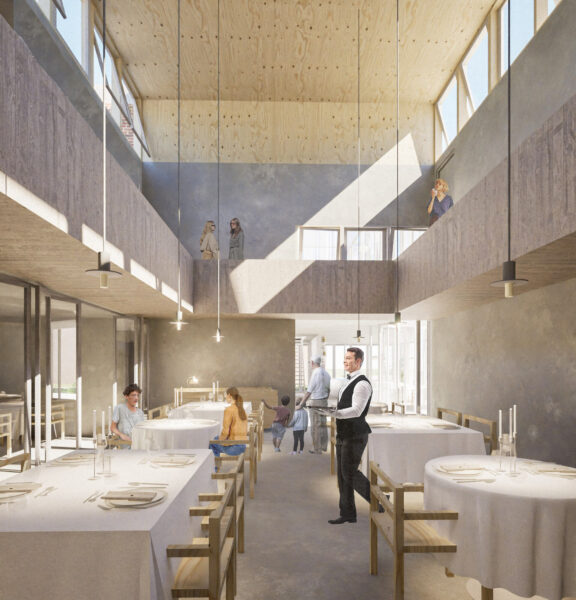
The heart of the project is the greenhouse. But not in the traditional sense of an enclosed greenhouse full of tomato plants. Serre D’op‘s greenhouses are modular, light structures designed to house not only plants, but also people. They are transparent, breathing, connected to their surroundings. Each greenhouse becomes a shared biotope: a place where biodiversity, urban agriculture, ecological awareness and social contact come together. So it is not only about greening, but also about socialising space. Greenhouses act as catalysts for meeting, care and cooperation. They are easily accessible, inviting and adaptable to the needs of the neighbourhood. Residents here gain access not just to a garden, but to a place to share, learn, and be part of a larger story. A greenhouse becomes a collective platform — a place where young people attend workshops, the elderly harvest herbs, neighbours experiment with composting, and schoolchildren learn about the importance of bees. The roof thus transforms from a dead spot into a vibrant community on high.
The choice of greenhouses is not accidental. Greenhouses are not only functional; they are also symbolically powerful. They form a bridge between inside and outside, between city and nature. They offer protection without closing off completely. In an urban context, they are ideally suited because they are usable all year round: they extend the growing season, protect plants from extreme weather conditions, and create a comfortable microclimate for people and nature. In addition, greenhouses have a strong architectural appeal: light and space are captured in a poetic way. Visible from the street, they are a sign of change, a signal that something new is growing above the grey roofline.
Ecologically, greenhouses also have important benefits. They contribute to climate adaptation by capturing water, reducing heat stress and enhancing biodiversity. They encourage local food production, shorten food chains and raise awareness around sustainable consumption. Combined with renewable energy or water recovery, they can become self-sufficient systems.
Greenhouse D’op aims to develop a rooftop community — a network of greenhouses on different rooftops, connected by a shared vision of sustainability and connectedness. The focus is on collective use and local ownership. This is not a project imposed from above, but one built together with residents, community operations and urban partners. Shared responsibility creates more social cohesion. People get to know each other better, become involved in their surroundings and feel more connected to their hometown. The greenhouses become places where stories are shared, where cultural differences fade and where care for nature goes hand in hand with care for each other.
Imagining the City of Tomorrow
Greenhouse D’op is more than a green roof. It is an alternative way of making city. Instead of continuing to think in terms of ground surface, this project challenges us to think vertically — to repurpose unused spaces and look differently at what is already there. The city of tomorrow is not just an efficient place, but a liveable place. A place where man and nature do not oppose each other, but exist in symbiosis. Where infrastructure is not only functional, but also meaningful. Where collective spaces emerge in unexpected places — on top of what was once only private. Greenhouse D’op shows that imagination, design and commitment are powerful engines for transformation.
Conclusion
In an era when cities are becoming increasingly crowded and functional, Serre D’op offers an alternative perspective: that of the city as a living organism, where space is created through collaboration, imagination and reuse. By transforming the roofs of Ghent into green greenhouses, we are turning the everyday into something extraordinary. We are not only creating new green space, but also new ways of living together. Greenhouse D’op is a future-oriented project that brings together ecology, architecture and community — an ode to the city as it could be.