Liam Gyselinck
Marqueterie op 17de-eeuwse Venetiaanse luiten.

musical instrument making

Mentoren:
Toon Lauwers
Yves Senden

Links:
Instagram

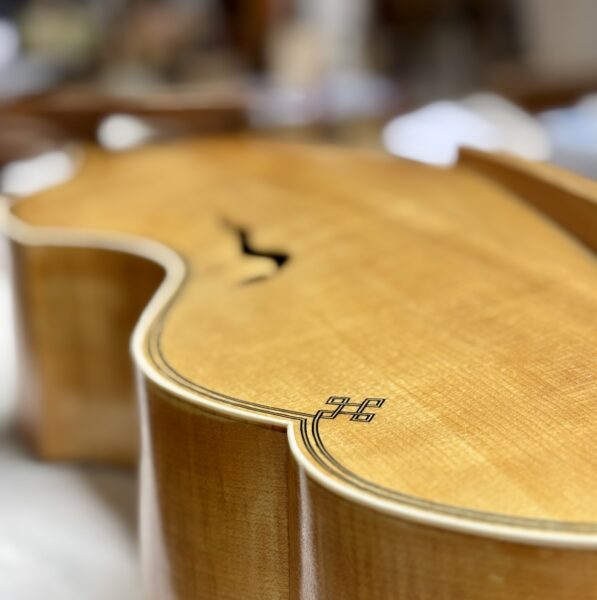
Venice was an epicentre for music, arts and crafts in the 17th century. In particular, musical instrument making flourished here, where craftsmanship and artistic refinement went hand in hand. The lute, one of the most popular instruments of the time, was appreciated not only for its rich sound, but also for its visual splendour. Venetian lutes of this period were often decorated with marquetry: a technique in which thin layers of wood, ivory or sometimes tortoiseshell of contrasting colours were carefully carved and inlaid into complex, arabesque patterns. These decorations mainly adorned the neck of the instrument and gave each specimen a unique character.

The marquetry was not purely aesthetic; it underlined the owner’s prestige and emphasised the lute’s status as both a musical instrument and a work of art. Venetian builders, including Matteo Sellas and Christoph Koch, knew how to strike a perfect balance between acoustic quality and ornamentation.

In this project, I focused mainly on two instruments by Christoph Koch, which remarkably display the negative version of the same marquetry. The fact that these two lutes in particular have survived a period of four centuries is exceptional and was the deciding factor for me in choosing them for my master project.